
Our History
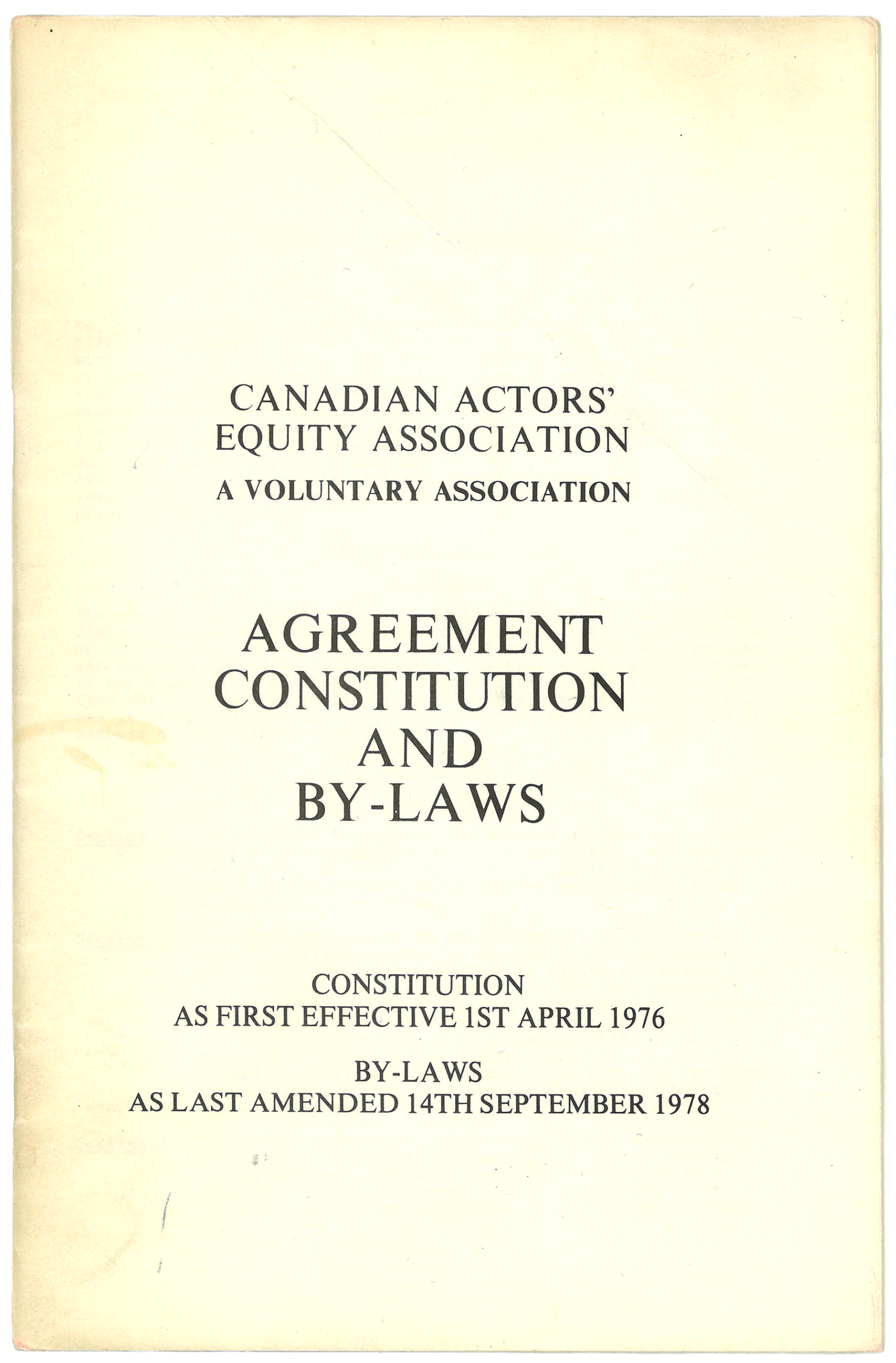
First Constitution of Canadian Actors’ Equity Association, 1976Canadian Actors Equity Association (CAEA) is “a voluntary association to advance, promote, foster and benefit all those connected with the art of the theatre and the performing arts in general.
How did we get here?
Anyone familiar with the history of North American theatre in the 19th and early 20th centuries knows the horror stories—the exploitation of artists by unscrupulous managers and producers. Wages and working conditions were set unilaterally by producers, and a performer could easily find themselves stranded without pay in a one-horse town in the Midwest when either the producer went bankrupt or the manager vanished with the funds.
While the rise of trade unions in the United States helped establish some basic rights for artists, the same protections didn’t yet exist in Canada. It wasn’t until after World War II—spurred by the sudden proliferation of summer stock theatres, the launch of the Stratford Festival, and the founding of regional theatres—that Canadian stage performers began to feel a pressing need for stronger representation and protections.
The Alliance of Theatrical Stage Employees (later the International Alliance of Theatrical Stage Employees (IATSE)) formed in the U.S.
The Dramatist Guild formed in New York
Actors’ Equity Association (AEA) formed in New York
Stratford Shakespearean Festival of Canada’s first season
New York Council of AEA unanimously approves proposals for establishing Equity’s jurisdiction over Canadian theatre
Dennis Sweeting becomes the first Canadian Representative of AEA
First membership meeting of the Canadian wing of Actors’ Equity
Lloyd Bochner elected as the first Chair (President) of the Canadian Equity Advisory Council
Larry McCance becomes AEA’s Canadian Representative, a position he would hold with distinction for twelve years
Montreal Advisory Committee formed
The Actors’ Fund of Canada formed and given space in the Equity office
First ballet agreement with National Ballet
First Royal Winnipeg Ballet Agreement
First opera agreement with Canadian Opera Company
Shaw Festival’s first season
Winnipeg Advisory Committee formed, later becoming the Manitoba Advisory Committee. Vancouver and Maritime Advisory Committees soon follow
First Canadian Theatre Agreement comes into effect
Finally, in the early 70s, the question was asked, “Where do we go from here?”
With the continued growth of an indigenous Canadian theatre industry, the idea of an independent association—one in which Canadian interests were represented solely by Canadians—became increasingly important. A Memorandum of Accord was drawn up between AEA in the United States and the Canadian branch of Equity, outlining a process for separation, as well as a constitution and bylaws for a new, autonomous Canadian association.
In August of 1975, the Canadian membership voted on the Memorandum and it passed with overwhelming support.
Dennis Sweeting, first Canadian Representative of AEA (1955)“They (New York Equity) said, when you’re ready to go, let us know, then shove off and be your own Union.”
After twenty-one years, on April 1, 1976, Canadian Actors’ Equity Association was officially formed
The Memorandum of Accord is passed by the Canadian membership
The Declaration of Separation and Reciprocal Agreement between AEA and Equity are passed by both boards
Canadian Actors’ Equity Association’s first Constitution comes into effect